
Uber blew its 2026 AI budget in 4 months. Nvidia’s VP said computers cost more than salaries. And 56% of CEOs got zero return from AI. Here’s the real story with actual 2026 data.
For two years, every headline said the same thing: “AI is coming for your job.” Companies laid off thousands. CEOs gave TED talks about “the future of work.” Everyone quietly started updating their LinkedIn.
But here’s what those headlines missed the actual bill. Right now, in 2026, AI costs more to run than the humans it was supposed to replace. And the world’s biggest companies are finding this out the hard way.
56%
of CEOs worldwide got zero financial return from AI
PwC Global CEO Survey · Jan 2026
4 month.
for Uber to burn through its entire 2026 AI budget
The Information · Apr 2026
$6.31T
global IT spend in 2026 — up 13.5% in a single year
Gartner · 2026
150K+
tech jobs cut in 2026 — the biggest wave in a decade
Layoffs.fyi · May 2026
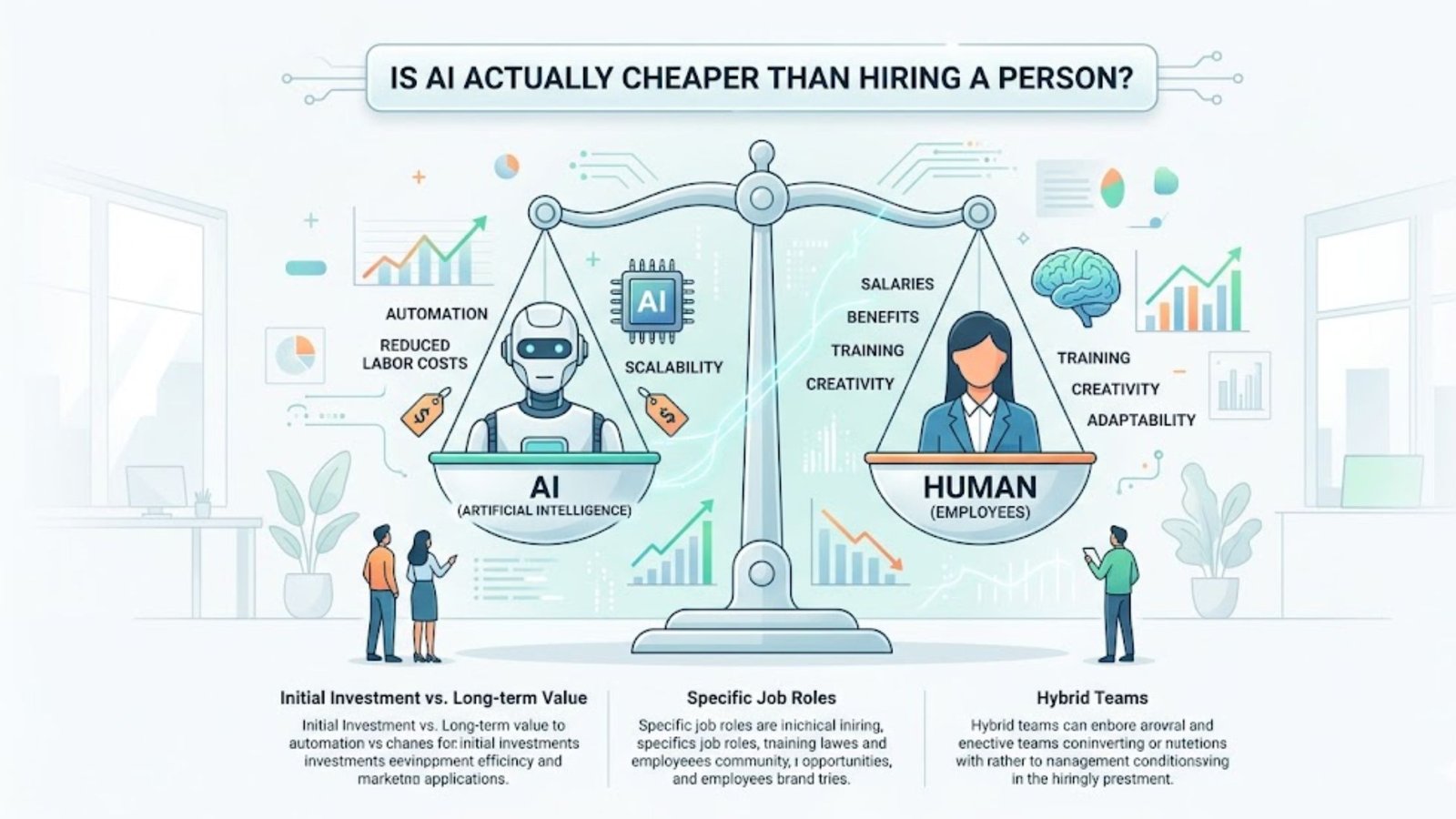
Is AI actually cheaper than hiring a person?
No. Not right now. Not for most jobs. And the people saying this aren’t journalists, they’re executives sitting inside the most AI-invested companies on the planet.
Bryan Catanzaro is the Vice President of Applied Deep Learning at Nvidia, the company that makes the chips powering all of AI. In April 2026, he told Axios something that stopped the industry cold:
“For my team, the cost of computers is far beyond the costs of the employees.” — Bryan Catanzaro, VP Applied Deep Learning, Nvidia · Axios, April 2026
Nvidia’s senior engineers earn between $192,000 and $243,000 a year. And AI still costs more than them. If it’s this expensive inside the company that manufactures the chips, what does it cost everyone else?
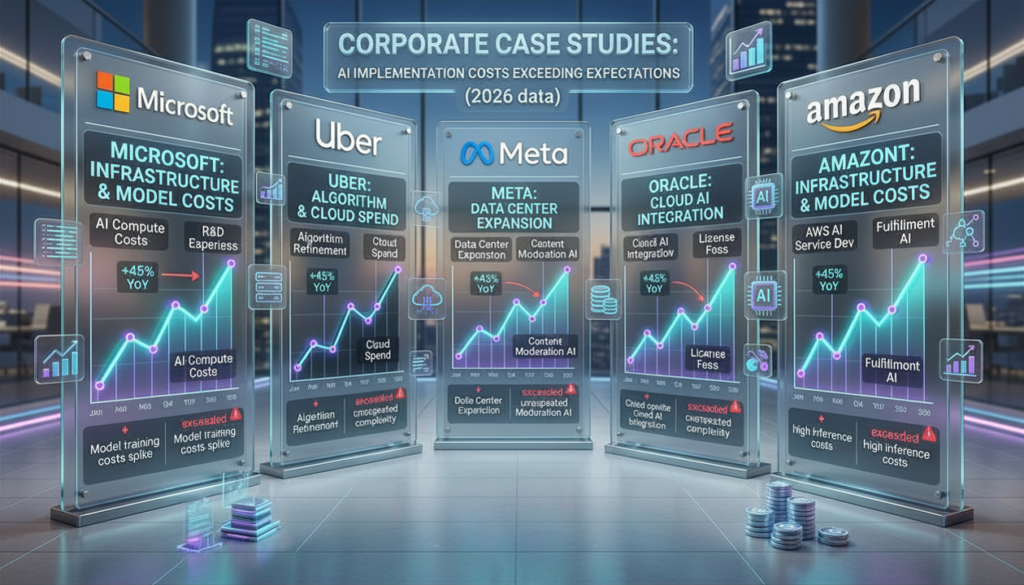
This isn’t a niche observation. It’s playing out at Microsoft, Uber, Meta, Oracle, and Amazon right now simultaneously. Let’s go through each one.
The real case studies what actually happened in 2026
These are not opinions. These are documented events from this year, reported by Fortune, The Information, CNBC, and Axios.
UBER: Burned 12 months of AI budget in just 4 months
Uber’s CTO Praveen Neppalli Naga went public with one of the most honest admissions of 2026: by April, Uber had already used up its entire annual AI coding tools budget. The year had barely started.
How? Uber ran internal leaderboards ranking teams by how much they used AI. Engineers loved the tools. By March 2026, around 84% of Uber’s engineers were using AI coding tools daily. Individual engineers were spending $500 to $2,000 per month on tokens alone. 70% of Uber’s code now originates with AI and 11% of live backend updates ship with no human in the loop at all.
“I’m back to the drawing board,” Naga said, “because the budget I thought I would need is blown away already.”
Budget blown 8 months early · $500–$2,000/month per engineer in tokens
MICROSOFT: Cancelled most Claude Code licences after costs spiralled
Microsoft encouraged thousands of employees engineers, designers, project managers to use AI coding tools. Adoption was strong. So were the bills. Costs rose faster than expected, and Microsoft began cancelling most of its direct Claude Code licences.
The company that earns billions selling AI tools found those same tools too expensive for its own staff. This is the same Microsoft that committed $80 billion to AI infrastructure in 2026 alone and still found per-employee AI costs unsustainable at scale.
Reversed aggressive AI adoption internally due to runaway costs
A responsive website design agency that understands SEO builds it into the site from the start: page structure, headings, site speed, mobile performance. Not as a plugin you add later.
NVIDIA: VP admits compute costs more than six-figure engineer salaries
Nvidia has more visibility into real AI running costs than any company on earth. Their VP Bryan Catanzaro confirmed: the bill for running AI models inside Nvidia now exceeds what Nvidia pays its highly-compensated engineers people earning $192,000 to $243,000 per year.
If this is true at the chip-maker, the cost implications for every other company using those chips downstream are even steeper.
AI compute costs exceed $240K/year engineer salaries
META : Built "Claudeonomics" to gamify AI spend then cut 10,400 jobs
A Meta employee created an internal dashboard called “Claudeonomics” named after Anthropic’s Claude to track which workers consumed the most AI tokens. Consumption became a competitive sport.
Meanwhile, Meta cut approximately 10,400 jobs in 2026. CEO Mark Zuckerberg confirmed further reductions in an internal memo dated April 23, noting the company was “resizing teams” while maintaining heavy AI investment. Meta’s AI capex is part of a combined ~$700 billion committed by Alphabet, Amazon, Meta, and Microsoft this year even as tens of thousands of employees are let go.
Gamified AI token consumption while cutting 10,400 jobs

ORACLE : Cut 30,000 jobs to fund AI data centres despite 95% profit surge
Oracle eliminated up to 30,000 positions roughly 20% of its global workforce while simultaneously reporting a 95% surge in net income to $6.13 billion. The layoffs are directly tied to redirecting capital into large-scale AI data centre investments.
TD Cowen analysts estimated eliminating 20,000–30,000 jobs could unlock $8–10 billion in incremental free cash flow cash going straight into AI infrastructure. This is the clearest example of the direct trade in 2026: people out, compute in.
30,000 jobs cut to fund AI despite record profits
AMAZON : Cut 16,000 corporate roles then told staff to "tokenmaxx"
Amazon confirmed 16,000 corporate role cuts in January 2026 the second major round since October 2025, when it cut 14,000 more. In its internal memo, Amazon framed cuts as reducing “bureaucracy,” while simultaneously encouraging engineers to “tokenmaxx” use as many AI tokens as possible.
AWS grew 24% in the same quarter, its fastest growth in 13 quarters. Revenue grew. Headcount shrank. The bet is clear: AI replaces the roles. Whether the economics actually support that bet is still the open question.
16,000 jobs cut while staff told to maximise AI token use
The 2026 layoff wave who got cut and by how much
By mid-May 2026, over 150,000 tech jobs had been eliminated the largest concentrated wave of workforce displacement in a decade. Here’s the breakdown:
| Company | Jobs Cut in 2026 | Reason Given | AI Spend Same Year |
|---|---|---|---|
| Oracle | ~30,000 (20% of workforce) | AI infrastructure expansion | $8–10B redirected to data centres |
| Amazon | ~30,000 | Reduce bureaucracy, shift to AI | Part of ~$700B combined Big Tech spend |
| Meta | ~10,400 | Efficiency + AI investment offset | Billions in AI capex committed |
| Dell | ~11,000 (10% of workforce) | Shift to AI server business | $569M in severance costs alone |
| Microsoft | Thousands (buyouts) | AI restructuring | $80B AI infrastructure commitment |
Bloomberg’s analysis found roughly half of AI-attributed layoffs will result in the same roles being rehired offshore or at lower salaries. That’s not labour replacement, it’s labour repricing. The “AI did it” framing is, in many cases, cover for a wage compression story.
What does the research actually say is AI delivering results?
PwC Global CEO Survey January 2026
PwC surveyed 4,454 CEOs across 95 countries and asked one simple question: is AI making you money? The answer was blunt.
56% of CEOs reported zero financial benefit from AI, no revenue gains, no cost savings. Only 12% said AI had delivered both cost reductions and revenue growth. Only 12 out of every 100 of the world’s most resourced business leaders. PwC’s global chairman Mohamed Kande said at Davos in January 2026: “This is one of the most testing moments for leaders.”
“Somehow AI moves so fast that people forget that to adopt technology you have to go to the basics.” Mohamed Kande, PwC Global Chairman · Davos, January 2026
Yale Budget Lab April 2026
Yale’s Budget Lab has been tracking AI’s actual impact on the US labour market every month. Their April 2026 update is clear: measures of AI exposure and automation show no significant relationship to changes in employment or unemployment.
Their conclusion: “The picture of AI’s impact on the labour market that emerges from our data is one that largely reflects stability, not major disruption.” That does not mean disruption isn’t coming. It means it is not here yet at the scale being sold to you.
The questions everyone is asking answered directly
Will AI replace most jobs soon?
Not cost-effectively, not right now. Yale’s Budget Lab confirmed in April 2026 that AI exposure has shown no significant relationship to unemployment changes. Companies are cutting jobs, but Bloomberg found half of those roles will be rehired at lower wages that’s salary compression, not replacement.
Why is AI so expensive if everyone says it's getting cheaper?
Token prices per unit are falling. But total consumption is rising faster. Goldman Sachs forecasts a 24-fold increase in token consumption by 2030 as agentic AI spreads. Cheaper per token does not mean cheaper overall Uber proved this perfectly. Their per-token cost was low. Their total bill blew past the annual budget in four months.
Which companies are actually getting value from AI?
PwC calls them the “Vanguard” the 12% of companies seeing both cost and revenue benefits. They share three traits: AI is embedded in actual products (not just internal tools), they have clean data foundations and governance, and they measure ROI in hard numbers not token usage metrics. Companies racing to maximise token consumption are the cautionary tale.
Should I be worried about losing my job to AI right now?
The real risk is not AI replacing you, it’s a human using AI doing your job more efficiently than you. By December 2025, 35.9% of US workers were already using generative AI tools (Yale Budget Lab / Hartley et al., 2026). Those using them well are more productive. Those who aren’t are becoming comparatively less competitive not because AI is cheaper, but because AI-augmented humans are getting more done.
Are tech layoffs really because of AI?
Partly. In March 2026, AI was cited as the reason for 25% of tech layoffs up from 10% the month before. But Bloomberg’s analysis found roughly half of AI-attributed layoffs will see the same roles rehired at lower wages offshore. Yale Budget Lab calls some of this “AI-washing” using AI as a PR-friendly justification for cuts driven by overhiring corrections and shareholder pressure.
Will AI ever be genuinely cheaper than humans?
For specific tasks at scale yes, and in some cases it already is. Large-scale document classification, image tagging, and content generation at volume can be cost-effective today. Replacing full job roles at competitive cost is further out. The broader problem: even as token prices fall, total AI infrastructure spend is projected to reach $5.2 trillion by 2030 (McKinsey). The bill keeps growing.
Ready to Elevate Your Brand?
Let’s work together to create a marketing strategy that delivers results. Contact us today to get started