
Let’s be honest, the way people search for things has changed dramatically. A few years ago, if you wanted to find the best digital marketing agency in your city, you’d Google it, scroll through a list of blue links, and start clicking. That’s still happening. But more and more people are skipping that step entirely and just asking ChatGPT or Perplexity instead.
And here’s the thing if your brand isn’t showing up in those AI-generated answers, you’re invisible to a fast-growing chunk of your potential audience.
That’s exactly what GEO (Generative Engine Optimization) is designed to fix. In this blog, we’ll break down what GEO actually is, how it’s different from traditional SEO, and what you can practically do to get your brand cited by AI search engines starting today.
What Is GEO And Why Should Your Business Care?
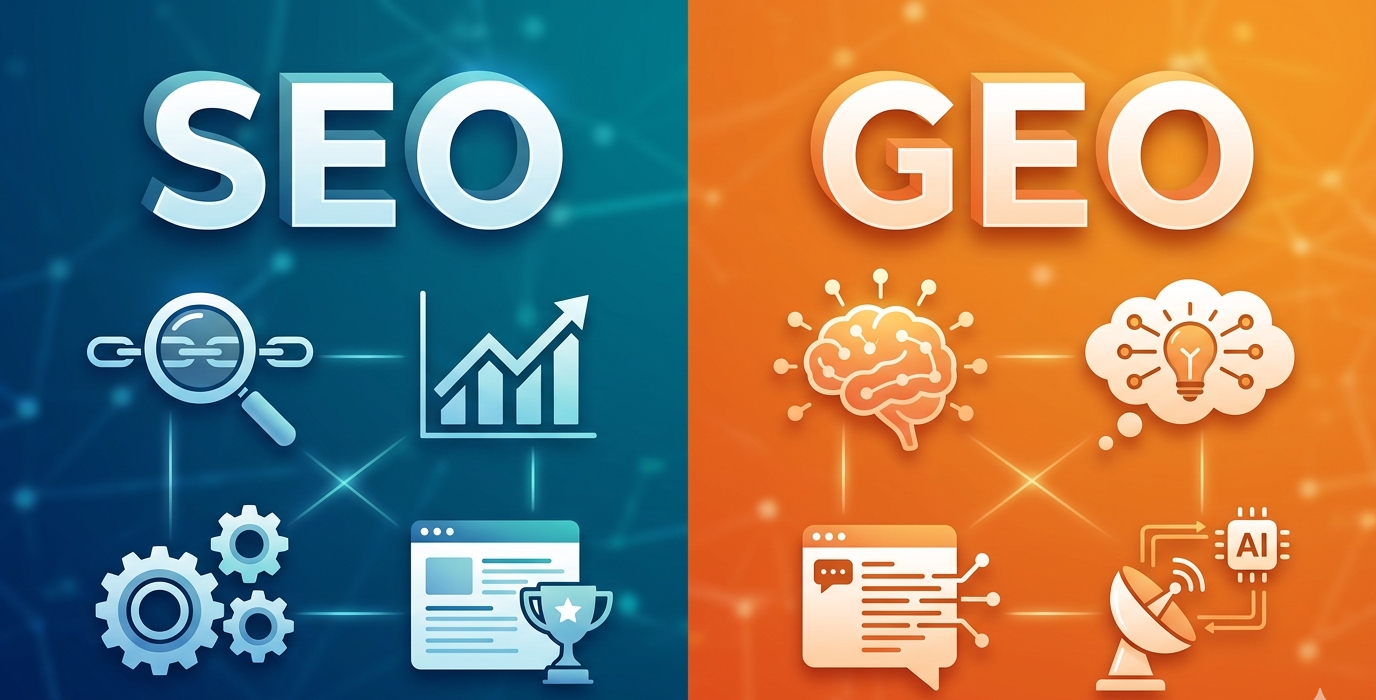
GEO stands for Generative Engine Optimization. In simple terms, it’s the practice of optimizing your content so that AI platforms like ChatGPT, Perplexity, Google AI Overviews, and Claude actually reference and cite your brand when answering user questions.
Think of it this way: traditional SEO gets you on page one of Google. GEO gets your brand directly inside the answer someone receives even if they never visit your website.
The numbers tell the story. According to Ahrefs, AI Overviews already reduced click-through rates for top-ranking Google content by 34.5% in just one year. Meanwhile, AI referrals to websites surged 357% year-over-year between 2024 and 2025. That’s not a small shift that’s a fundamental change in how discovery works.
For any digital marketing agency or business trying to grow online, ignoring GEO right now is like ignoring mobile optimization back in 2012. You’ll feel fine for a while, and then suddenly you won’t.
GEO vs SEO: What's Actually Different?
Let’s clear this up quickly because there’s a lot of confusion about this. GEO does not replace SEO. Not even close. They work together. But they operate differently, and understanding those differences is what separates good digital marketing strategy from great digital marketing strategy.
How Traditional SEO Works
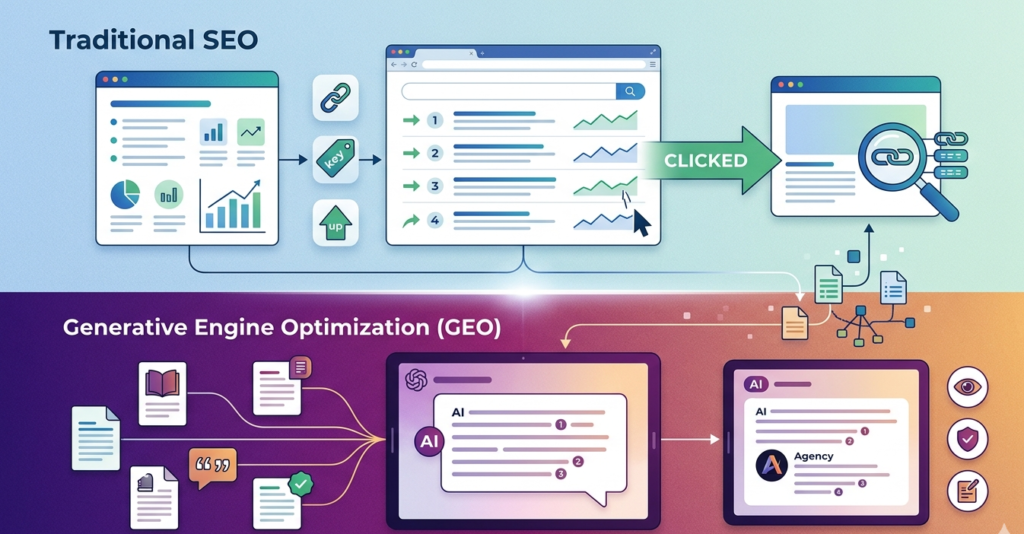
SEO (Search Engine Optimization) is built around getting your web pages to rank in Google’s search results. You target keywords, build backlinks, optimize your on-page content, improve page speed, and work to climb up the rankings. It’s a well-understood process, and it still works.
Google still processes over 14 billion searches per day. ChatGPT handles about 37 million — that’s 373 times less. So no, SEO is not dying. Anyone telling you to abandon SEO entirely is selling you something.
But here’s the catch with SEO: 65% of Google searches now end without a single click to any website, according to industry research. Featured snippets, AI Overviews, and knowledge panels are answering questions right on the results page. The traffic you used to count on? Some of it is simply not coming anymore.
How GEO Works Differently
GEO shifts the goal from ‘rank on page one’ to ‘be the source AI trusts.’ When someone asks Perplexity ‘which is the best local SEO marketing agency in Alberta?’ GEO is what determines whether your brand gets mentioned in that answer.
Here are the key differences between the two:
- SEO optimizes for clicks from a ranked list. GEO optimizes for citations inside a synthesized answer.
- SEO rewards long-form pages covering a broad topic. GEO rewards self-contained paragraphs that can be extracted and attributed on their own.
- SEO rankings can hold steady for months. GEO citations are fresher 50% of content cited in AI answers is less than 13 weeks old.
- SEO measures success through traffic and rankings. GEO measures success through brand mentions, AI citations, and share of voice in AI responses.
The best brands right now, especially the top digital marketing agencies are doing both. Strong SEO gives you the authority foundation. GEO builds on top of that to make you visible in AI-first environments.
How AI Engines Actually Decide What to Cite
This is the part most people don’t think about. AI platforms aren’t picking random results. They’re making trust decisions based on specific signals. If you understand those signals, you can work with them instead of against them.
Entity Recognition and Brand Consistency
AI systems are built around understanding ‘entities’ clearly defined people, organizations, products, and concepts that a language model can recognize and reference confidently. If your brand isn’t clearly defined across the web, AI has no way to talk about you accurately.
Think about how Contentful gets referenced in AI responses as ‘a digital experience platform.’ That’s not an accident, it’s the result of consistent, clear brand messaging across multiple authoritative sources. The AI has learned what Contentful is and can reference it with confidence.
For a seo agency alberta or local seo marketing agency, this means making sure your business is described consistently everywhere on your website, your Google Business Profile, industry directories, PR mentions, and third-party review sites. Inconsistency creates confusion for AI models.
Content Freshness Matters More Than You Think
AI citation behavior strongly favors recent content. Research from Seer Interactive found that over 80% of AI-driven traffic went to pages updated within the past two years, and only 3.6% went to pages older than four years.
For a ppc marketing agency or any service business, this is actionable: go back and update your old high-value blog posts with current statistics, new examples, and a clear ‘Last Updated’ date. That simple step can meaningfully improve your chances of being cited.
Structure That AI Can Actually Extract
AI systems retrieve content at the paragraph level, not the page level. That means each section of your content needs to stand on its own. If someone fed only one paragraph of your blog into ChatGPT, would it still answer a specific question? If yes, you’re writing GEO-friendly content. If no, you need to rethink your structure.
Clear headings, direct answers at the start of each section, short paragraphs, FAQ sections, and cited statistics all dramatically increase the chances of AI pulling from your content.
Practical GEO Steps for Your Digital Marketing Agency
Enough theory here’s what a digital marketing agency can actually do right now to improve GEO performance. These aren’t abstract ideas. These are tactics that are already working.
- Write answers first, context second. Lead with your direct answer in the first 200 words. Don’t build up to the point, make the point, then support it.
- Use real data and original research. AI systems prefer citing content with verifiable statistics. Run a survey, publish an industry benchmark, or compile original data. That kind of content becomes a citation magnet.
- Build your presence beyond your website. AI pulls from Reddit threads, Quora answers, industry publications, LinkedIn articles, and podcast transcripts. If your expertise only lives on your website, you’re leaving GEO visibility on the table.
- Make your authors visible and credentialed. Anonymous content is a GEO penalty. Name your authors, include their credentials, link to their LinkedIn profiles. AI systems increasingly weight author authority.
- Add structured FAQ sections to key pages. FAQ content is one of the most commonly cited formats in AI answers. If your service pages don’t have them, add them now.
- Keep your NAP (Name, Address, Phone) consistent everywhere. For any local seo marketing agency targeting a specific geography, consistency across directories, Google Business Profile, and your website is essential for local GEO visibility.
- Get cited in industry publications and listicles. Appearing in ’10 top digital marketing agencies in Alberta’ type content on reputable sites is exactly what feeds AI recommendation engines.

Frequently Asked Questions
Is GEO replacing SEO?
No, GEO is an additional layer on top of SEO, not a replacement. Brands that do well in GEO are almost always the same ones with strong SEO foundations. Traditional SEO still drives far more traffic volume. GEO builds visibility in AI-generated responses, which is a growing and valuable channel on top of traditional search.
How do I know if my brand is being cited by AI search engines?
Tools like Semrush’s Enterprise AIO now let you monitor your brand’s visibility across AI platforms including ChatGPT, Google AI Mode, and Perplexity. You can track mentions, sentiment, and share of voice compared to competitors. Even without paid tools, you can manually test this by asking AI platforms questions your target customers would ask and seeing whether your brand appears.
Does this apply to local businesses and local SEO marketing agencies?
Absolutely. Local service businesses actually have a strong opportunity here. When someone asks ChatGPT ‘best digital marketing agency near me’ or ‘seo agency alberta,’ AI engines pull from Google Business Profiles, local directories, review sites, and consistent local citations. Making sure your local presence is clean, consistent, and well-reviewed directly feeds into local GEO visibility.
What content types work best for GEO?
Research reports, data-driven articles, comprehensive FAQ sections, step-by-step guides, and structured comparison pieces all tend to perform well for GEO. Short, direct, well-structured content that can be extracted one paragraph at a time works better than long, flowing narrative essays that don’t break into clear, standalone sections.
How quickly can GEO results show up?
This varies by platform. Google AI Overviews pulls live from the web, so well-optimized, freshly updated content can appear relatively quickly —sometimes within weeks. ChatGPT uses a combination of training data and live search depending on the version, which makes timelines less predictable. The best approach is to treat GEO as an ongoing content strategy rather than a one-time fix.
Should small businesses and agencies invest in GEO, or is it only for large brands?
Early movers in GEO actually have a significant advantage right now, especially smaller players. Most large enterprises are still focused entirely on traditional SEO. For a ppc marketing agency or local seo marketing agency that publishes authoritative, structured, well-cited content consistently, the citation space in AI answers is still relatively open. The brands building GEO authority now will be very hard to displace in 12 to 18 months.
The Bottom Line
Search is not broken. It’s just bigger now. People still Google things billions of times a day. But they’re also asking AI assistants, getting answers without clicking, and trusting what AI platforms cite as authoritative.
For any digital marketing agency whether you’re a boutique seo agency in Alberta or one of the top digital marketing agencies serving national clients GEO is not a trend to watch from the sidelines. It’s something to act on now, while the space is still relatively uncrowded.
The brands winning in 2026 aren’t choosing between SEO and GEO. They’re doing both and they’re building authority that shows up wherever their customers are searching.
Start with your most important service pages. Update them, add FAQ sections, cite real data, name your authors, and distribute your expertise beyond your website. Those steps alone put you ahead of most of your competition in both traditional search and AI-generated answers.
Ready to Elevate Your Brand?
Let’s work together to create a marketing strategy that delivers results. Contact us today to get started