
You launched your business. Then grabbed a Wix or Squarespace template, paid a few hundred dollars, and got online. Smart move at the time.
But now your business is different. You have more services, more clients, maybe a second location. And your website, the one that made total sense three years ago, is starting to feel like it belongs to a different company.
So you start asking questions. Should I rebuild it? Is the template still fine? How much is this going to cost me? Is any of this actually worth it?
Those are fair questions. Let’s go through them one by one.
My business has grown. Why does my website still feel like it's holding me back?
Because it probably is.
A template is built for the version of your business that existed when you signed up for it. Fixed layout. Fixed sections. Limited control over how things look, what pages you can add, and what the site can actually do.
When your business was small, those limits didn’t matter. Now they do.
You want to add a booking system. The template doesn’t support it without a clunky third-party plugin. You want a separate page for each city you serve, the template starts looking broken when you force new content into it. You want your site to actually look like your company, not a Squarespace site with your logo on it.
That’s not a design problem. That’s a structural one. And you can’t fix a structural problem by changing your font or picking a new colour scheme.
How much does a real website actually cost? I keep getting quotes all over the place.
This is the most common question and the most frustrating one, because the range is genuinely wide.
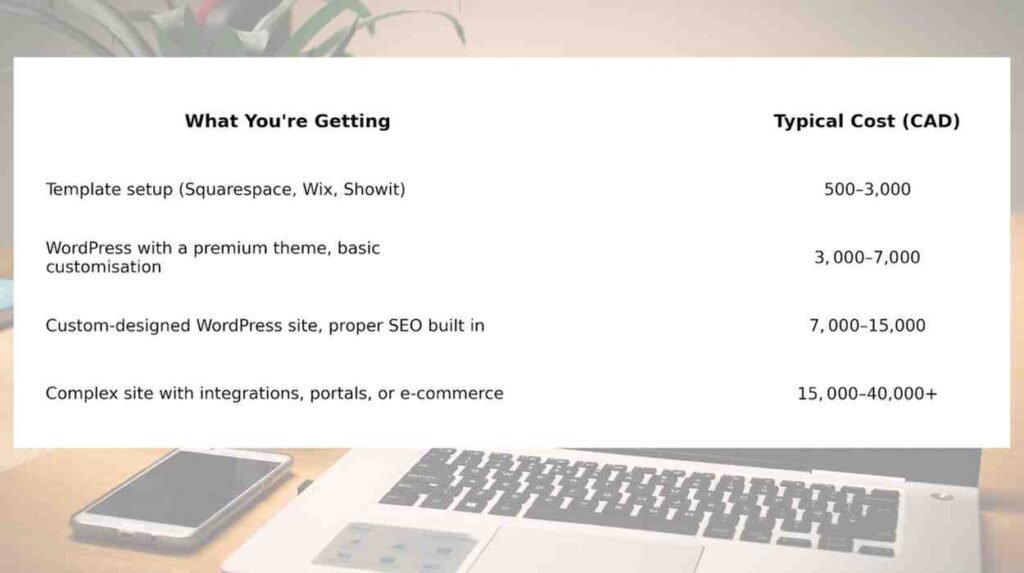
The reason quotes vary so much: one agency is applying a template and calling it custom. Another is actually designing and building from scratch. You need to ask specifically — “is this a template or is this built for my business?”
One more thing to keep in mind. A $1,500 template site that needs to be rebuilt in two years costs more than a $10,000 custom site that runs clean for five. The cheap option has a habit of becoming expensive.
Is a template website good enough, or do I actually need something custom?
Depends on where your business is right now.
A template is genuinely fine if you are early stage, testing an idea, or just need a basic online presence so people can find your phone number and see what you do. No shame in that. Templates exist for a reason.
But a template starts working against you when:
Your website is part of how you win clients, not just a place people land after they already decided to call you. If someone Googles your service in your city and lands on your site, and that site looks generic or loads slowly or doesn’t answer their questions quickly. They click back and call your competitor.
You need the site to do something specific take bookings, process payments, connect to your CRM, show different content to different types of visitors. Most template platforms cap out fast when real functionality is needed.
You’re in a competitive market and your competitors have invested in their websites. A prospect comparing three companies will notice the difference. They may not be able to explain why one site feels more trustworthy than another, but they feel it.
A good website design & development company will tell you honestly whether you need custom or whether a well-configured WordPress setup will do the job. If they push custom on everyone regardless of budget or business size, that’s a flag.
Why is my website not showing up on Google? I've had it for two years.
This comes up constantly. The business owner pays for a site, launches it, and then waits. Nothing happens.
A few honest reasons why:
The site was built without SEO in mind. A developer who builds sites is not automatically an SEO specialist. If nobody set up your Google Search Console, structured your pages correctly, wrote your title tags and meta descriptions, or made sure your content matched what people are actually searching . Google has no strong reason to rank you.
Template platforms have built-in SEO limits. Squarespace, for example, has documented issues with how it handles technical SEO, including structural problems that limit how well search engines can read your pages. You can do a lot within the platform, but you hit a ceiling.
The content on your site doesn’t match what your customers are searching. Your homepage says “we provide exceptional services to our valued clients.” Nobody is searching for that. They’re searching “commercial cleaning company Grande Prairie” or “web design for contractors Alberta.” If your pages don’t speak that language, Google doesn’t connect you to those searches.

A responsive website design agency that understands SEO builds it into the site from the start: page structure, headings, site speed, mobile performance. Not as a plugin you add later.
My competitor's website looks way better than mine. Is that actually costing me business?
Probably yes depending on how clients find you.
If 100% of your business comes from word-of-mouth and personal referrals, your website matters less. The referral vouches for you before the prospect even lands on your site.
But most businesses have a mix. Some referrals. Some Google searches. Some people who heard about you at an event or saw your truck and Googled your name.
All of those people, even the warm referrals, will check your website before they call. What they see either confirms the trust someone already built for you, or quietly undermines it.
A slow site. An outdated logo. Services you no longer offer. Photos from 2017. A mobile layout that looks broken. None of these things will make someone say out loud “I didn’t call them because of their website.” But they will make someone hesitate just long enough to call the next name on their list.
You won’t see this in your analytics. You’ll just see a close rate that’s lower than it should be.
Someone built my website and now I can't get hold of them. I don't have my passwords. What should I do?
This is more common than it should be.
First step: check if you own the domain. Go to a domain lookup tool like who.is and search your website address. It will show who the domain is registered to. If it’s your developer’s name or their agency, that’s a problem you need to fix immediately, because they technically control your web address.
Second: your hosting. If your site is on a platform like Squarespace or Wix, try to recover account access through the email you used to sign up. If it’s on WordPress hosted somewhere, contact the hosting company directly with proof of business ownership. Most reputable hosts will work with you.
Third: your WordPress admin access. If you have the domain and hosting but lost admin login, a developer can recover access directly through the database. It’s not complicated if the hosting is accessible.
The bigger lesson: always own your own domain. Always have your own hosting account. Always get all login credentials in writing when a project ends. A best website development agency hands everything over at launch, if yours didn’t, that tells you something.
Do I need to rebuild from scratch, or can I just update what I have?
Not always from scratch, but it depends on what’s actually wrong.
If your current site is slow, broken on mobile, and structured in a way that makes it hard to update or expand. Rebuilding is usually faster and cheaper than trying to fix all of that on top of a shaky foundation. Patching a template that was never built for your business is like renovating a house that was built for someone else’s floor plan.
But if the structure is solid, meaning it’s on WordPress, it loads reasonably well, it’s mobile-responsive, sometimes a redesign of the pages, updated content, and proper SEO work is enough. You don’t always need to throw everything out.
A good starting audit: run your site through Google PageSpeed Insights (it’s free). If your mobile score is below 50, that’s a real problem. Check your bounce rate in Google Analytics. If people are landing and leaving in under 10 seconds at a high rate, the site isn’t holding them. Those two data points alone tell you a lot.
What do I actually need to hand over to a developer to get started? I have no idea what the process looks like
More people are stuck here than will admit it. They want a new website but they don’t know what to bring to the first conversation, so they keep putting it off.
Here’s what you actually need:
- Your domain login. The account where you registered your web address (GoDaddy, Google Domains, Namecheap. Wwhoever you used). You don’t need to do anything with it yet, just know you have access.
- A rough list of your services. Not a final version. Just a working list of what you do, who you do it for, and what cities or areas you cover.
- A few websites you like. Doesn’t have to be your industry. Just three sites where you thought “that looks like a real business.” It tells the designer more than you think.
- Your brand assets if you have them. Logo file (ideally a vector or PNG with transparent background), brand colours if you know them, any existing photos of your team or work.
- An honest answer to: what do you want people to do when they land on your site? Call you? Fill out a form? Book a time? Buy something? If you don’t know the answer to this, no developer can build a site that converts.
That’s genuinely it. The best website design company will guide you through the rest. You don’t need to know anything technical. You need to know your business.
Frequently Asked Questions
Yes. WordPress powers over 43% of all websites on the internet. For Canadian businesses, it gives you full ownership of your site, total flexibility to add functionality, and the ability to hand it to any developer in the future without being locked into one company. A wordpress website design agency that builds properly on WordPress gives you a site you control, not one you rent.
A standard 10 to 15 page custom site takes 4 to 6 weeks with a focused team. E-commerce or sites with custom integrations typically take 8 to 12 weeks. If someone promises a full custom site in under 2 weeks, it's a template.
It can, but it has a lower ceiling. Template platforms limit how much you can control page speed, code structure, and technical SEO. A custom-built site gives a responsive website design agency full control over every ranking factor. That control compounds over time.
Run it through Google PageSpeed Insights (free tool, search it). Check the mobile score specifically. Then open your site on your own phone not in a desktop browser previewing mobile, on your actual phone on cellular data. That's what your clients see. If it loads slow or looks off, they notice too.
Usually: who is actually doing the work, and how much strategic thinking goes into it. A $2,000 "custom" website is often a template with your content dropped in. A $12,000 custom website involves a discovery process, custom design decisions based on your customers, proper SEO architecture, and a developer who understands why each page is structured the way it is. You're not just paying for code. You're paying for decisions.
Ask them directly: what does post-launch support look like? How do I reach you if something breaks? Do I own everything at the end of the project? A serious agency has clear answers to all three. If they go vague, that's your answer.
If your website is part of how your business wins clients, even partly. It’s worth treating it like a business asset, not a one-time expense you set and forget.
The businesses showing up ahead of you in Google searches and closing more inbound leads aren’t doing anything magic. They just invested in a site that was built for how their customers actually behave.
Ready to Elevate Your Brand?
Let’s work together to create a marketing strategy that delivers results. Contact us today to get started